
New CMS Regulations Require Real-Time Eligibility Verification for Supplemental Benefit Debit Cards, Raising the Compliance Bar for Every Medicare Advantage Plan
The Rules Governing Medicare Advantage Flex Cards Are Changing
Effective January 1, 2027, Medicare Advantage organizations using debit or flex cards for supplemental benefits will be expected to support real-time eligibility verification at the point of sale. In other words, it's no longer enough to approve the merchant. Plans must verify the benefit.
For years, many health plans have relied on merchant category codes (MCCs) to determine whether a transaction was eligible. MCCs only tell part of the story. They can identify where a purchase occurs, but not always what was purchased. That distinction is at the heart of CMS's new guidance, and it has significant implications for how supplemental benefits are administered, monitored, and audited going forward.
For Medicare Advantage organizations offering Dental, Vision, Hearing (DVH), OTC, healthy foods, transportation, rewards and incentives, or other supplemental benefits, the message is clear: now is the time to evaluate whether your flex card platform is ready for what's next.
CMS Raised the Bar for Flex Card Compliance
On April 2, 2026, the Centers for Medicare & Medicaid Services (CMS) released its Contract Year 2027 Medicare Advantage and Part D Final Rule, introducing several policy updates designed to improve program integrity, member experience, and oversight of supplemental benefits.
One of the most significant changes affects supplemental benefit debit cards. Centers for Medicare & Medicaid Services (CMS), Contract Year 2027 Medicare Advantage & Part D Final Rule, states that plans administering supplemental benefits through debit cards must ensure:
The rule also specifies that debit cards should be limited to the applicable plan year. More importantly, CMS is shifting the industry away from validating where a purchase occurs toward validating what is being purchased.
That distinction changes everything.
Historically, many supplemental benefit card programs relied primarily on merchant category codes (MCCs), approving transactions based largely on the type of merchant rather than the specific item or service being delivered.
CMS is now signaling that plans should have the ability to verify benefit eligibility through real-time electronic integration at the point of sale, providing stronger assurance that plan funds are being used only for covered benefits. While the Final Rule does not prescribe a specific technical architecture, it clearly establishes a higher expectation for transaction-level validation and auditability.
From Merchant Validation to Benefit Validation
For many years, supplemental benefit card programs have operated using a relatively straightforward process:
- A member visits an approved merchant
- The payment card confirms that the merchant belongs to an approved merchant category
- The transaction is approved
While this model has enabled broad adoption of supplemental benefit cards, it has inherent limitations. For example, a merchant may sell both covered and non-covered products. Merchant category codes alone cannot distinguish between an eligible dental service and an unrelated retail purchase, or between an approved hearing benefit and a non-covered consumer item.
CMS's updated guidance reflects the growing maturity of the Medicare Advantage market and the increasing sophistication of supplemental benefits. Rather than validating only the merchant, plans are now expected to validate the covered benefit itself.
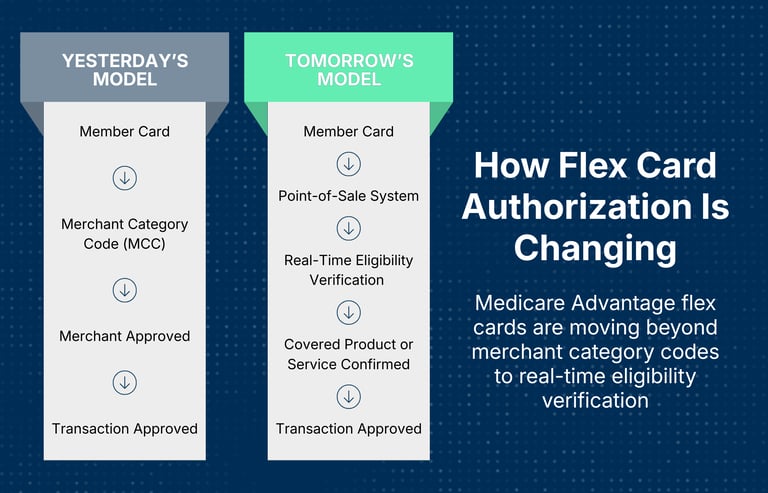
It's a fundamental shift in how supplemental benefits are administered. Real-time verification provides stronger compliance controls while also creating greater transparency into benefit utilization, member behavior, and program effectiveness.
For health plans, the benefits are immediate:
- Better compliance with evolving CMS expectations
- Improved financial stewardship
- More accurate reporting and audit readiness
- Reduced risk of inappropriate benefit utilization
- Greater confidence that supplemental benefit dollars are supporting intended member outcomes
What Health Plans Need to Evaluate Now
Let's be clear: CMS is not eliminating supplemental benefit debit cards. It is raising expectations for how they operate. Health plans should evaluate whether their current technology partner can support:
- Real-time benefit eligibility verification
- Electronic integration with providers or point-of-sale systems
- Transaction-level validation of covered products and services
- Controls to prevent non-covered purchases
- Audit-ready reporting
- Flexibility as CMS guidance continues to evolve
These capabilities are quickly becoming table stakes. Choosing the right technology partner is becoming a strategic infrastructure decision. Vendor reviews, technical integrations, compliance approvals, testing, and member communications all take time. Plans that start now will be better positioned than those waiting until late 2026.
Turning Compliance Into Competitive Advantage
This is more than a compliance discussion. It is an opportunity to modernize how supplemental benefits are delivered.
Joe's point underscores a larger shift: compliance and member experience are no longer separate conversations.
As the Medicare Advantage market continues to grow, the stakes are rising. According to KFF, Medicare Advantage enrollment now represents more than half of all eligible Medicare beneficiaries, underscoring the need for scalable, technology-enabled approaches to benefit administration.
Real-time eligibility verification can help reduce confusion at checkout, give providers greater confidence, improve reporting accuracy, and create stronger audit trails.
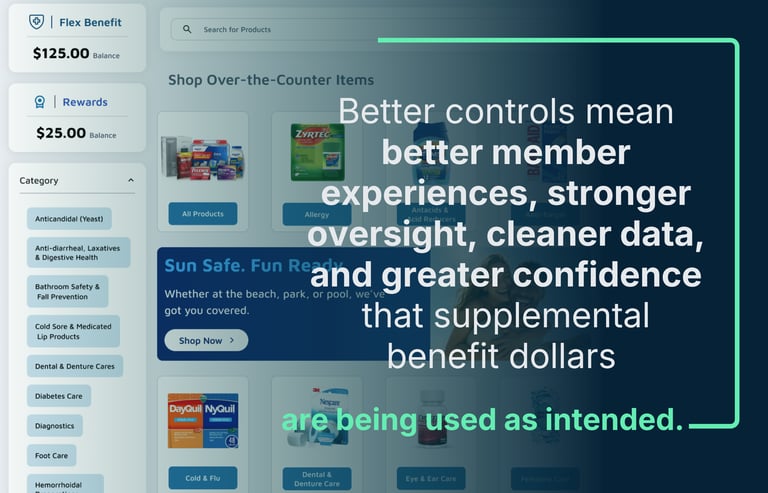
For health plans, the value goes beyond regulatory readiness. Better controls mean better member experiences, stronger oversight, cleaner data, and greater confidence that supplemental benefit dollars are being used as intended.
Why Dental, Vision, and Hearing Programs May Be Better Positioned
Dental, Vision and Hearing (DVH) programs may be better positioned than many other supplemental benefits to adapt to CMS's evolving expectations.
Unlike many retail-based supplemental benefits that have historically relied on merchant category codes (MCCs), DVH benefits are naturally tied to provider-based services where eligibility, benefit design, and covered procedures can be validated more precisely. This creates an opportunity for health plans to move beyond merchant-level authorization toward service-level adjudication.
Traditional Model
- Merchant Category Code (MCC) validation
- Merchant-level approval
- Limited visibility into what was actually purchased
- Greater potential for inappropriate benefit utilization
- Limited audit transparency
Next-Generation Model
- Real-time benefit verification
- Transaction-level validation
- Electronic provider integration
- Covered service confirmation
- Improved auditability
- Enhanced compliance controls
CMS has not prescribed a specific technical architecture or vendor model. However, the direction is clear: plans should be able to verify that supplemental benefit dollars are being used for covered products and services at the point of sale.

For organizations investing heavily in supplemental benefits, this represents an opportunity to modernize infrastructure while strengthening compliance, improving member satisfaction, and building greater confidence among provider partners.
Supplemental Benefits Need Modern Payment Infrastructure
Healthcare payments have become digital, connected, and increasingly intelligent. Supplemental benefits should be no different. Claims are adjudicated electronically. Eligibility is verified in real time. Benefits are coordinated across multiple systems. Supplemental benefits should evolve alongside the rest of healthcare.
Members expect the same seamless payment experience they receive from banks, retailers, and other digital-first brands. At the same time, regulators expect stronger governance, greater transparency, and better stewardship of plan dollars.
Modern payment infrastructure enables:
- Personalized benefit programs
- Dynamic member incentives
- Digital wallet experiences
- Provider-integrated payment solutions
- Real-time eligibility verification
- Enhanced analytics and reporting
The CMS Final Rule is more than a compliance milestone, it reflects the broader evolution of healthcare payments.
This shift reinforces a broader trend across healthcare: payment technology is no longer simply about processing transactions. It is becoming an integral part of benefit administration, compliance, member engagement, and care delivery.
How Lynx Supports the Next Generation of Supplemental Benefits
Lynx was built for a more connected model of benefit administration. Instead of relying solely on merchant-level controls, Lynx helps health plans administer supplemental benefits through configurable payment technology, real-time decisioning, provider connectivity, and transaction-level validation.
That's exactly the direction CMS is heading.
For Dental, Vision, and Hearing programs in particular, Lynx’s relationship and technical integration with CareCredit supports provider-based payment experiences that can help validate eligible services at the point of sale.
For health plans, that means:
- Real-time benefit verification
- Flexible supplemental benefit design
- Provider-integrated payment experiences
- Better member engagement
- Stronger compliance controls
- More actionable reporting
More to Explore

As the Medicare Advantage market continues to..
Connecting Care, Benefits, and Payments in Real..
How Combining Flex Cards and Rewards Builds..